Barbora Hinnerova
LOCATION DATA
4 MINS READ
Where Should You Open a Branch to Get More Customers?
Find out how to evaluate a location by estimating how many people are present in the area each day and how attractive it is to people.
Choosing a location for a new branch, store, or service point always starts with one fundamental concern: will there be enough people around this place on a daily basis? No matter how strong the concept is, a location without people rarely works in the long run.
What makes this decision difficult is that people are unevenly distributed across cities and regions. Some streets feel empty despite being central, while others consistently attract crowds. Understanding where people actually are — and how many of them — is the key to choosing a location with real business relevance.
Why is location a key factor for a business?
A business location has a direct impact on operational costs and on how easily customers can access your services. A poorly chosen location can seriously limit a company’s ability to generate sufficient revenue. On the other hand, high visibility and good accessibility often lead to stronger customer loyalty and repeat visits.
Simply put, a well-chosen location attracts customers, while a bad one drives them away. A prestigious address also signals credibility and professionalism, which matters not only to customers but to investors as well. Since location decisions are difficult and costly to reverse, it is crucial to get them right the first time.
How do I know if a location has enough people around it?
Traditionally, this question was answered through site visits, intuition, or rough assumptions based on nearby streets or landmarks. While useful, these approaches are subjective and hard to compare across multiple locations.
A more reliable way is to work with an estimated daily number of people present in the area. This provides a clear, comparable signal of how lively or quiet a place actually is, without relying on guesswork or time-consuming one-time observations.
What makes a business location attractive for people in the first place?
People concentrate around places tied to their everyday routines. These include transport stops, shopping areas, services, offices, schools, healthcare facilities, and leisure venues. Such places act as natural magnets, shaping where people move and where they spend time during the day.
A location surrounded by these activities is more likely to be noticed, passed by, and visited repeatedly. This does not guarantee success, but it creates the necessary conditions for visibility and demand.
How can I compare different business locations objectively?
Comparing locations becomes much easier when they can be evaluated using the same metric. Instead of vague impressions like “busy” or “quiet”, you can work with a numerical estimate of daily presence.
This allows you to put locations side by side and clearly see which ones are exposed to more people. Streets, districts, or even entire cities can be compared in a consistent way, helping you narrow down options early in the decision process.
How can I measure how many people are around a location?
The number of people around a location can be measured in several ways, ranging from manual counting and camera-based footfall sensors to mobile mobility data, traffic counts, and residential demographics.
Each of these methods captures only part of the picture — a single point in time, device movement, or the number of residents. For location selection, a model-based estimate of daily people presence is therefore often the most practical approach.
It uses surrounding activities and places that attract people to estimate how many individuals are typically present in an area, making it possible to compare multiple locations consistently before committing to detailed measurements or investments.
How can I see where people concentrate across a city or region?
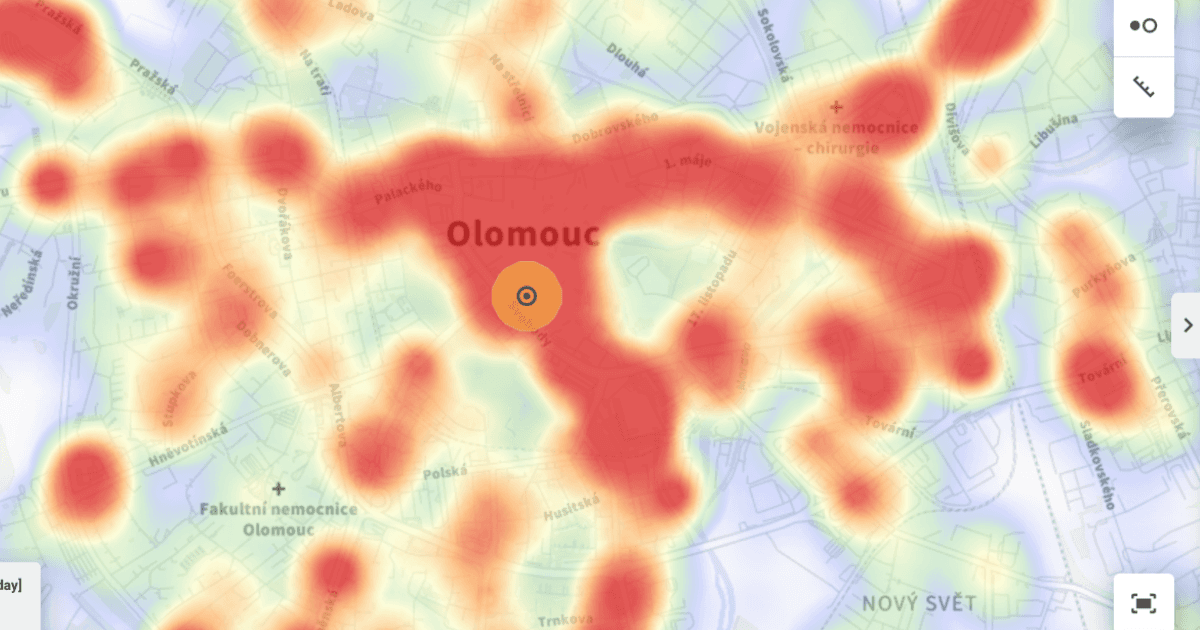
One of the most effective ways to understand people’s distribution is through heat maps. Heat maps visually highlight areas with higher and lower concentrations of people, making patterns immediately visible.
Instead of scanning tables or reports, you can quickly identify hotspots, transitions between busy and quiet zones, and areas that may be overlooked but still have meaningful presence.
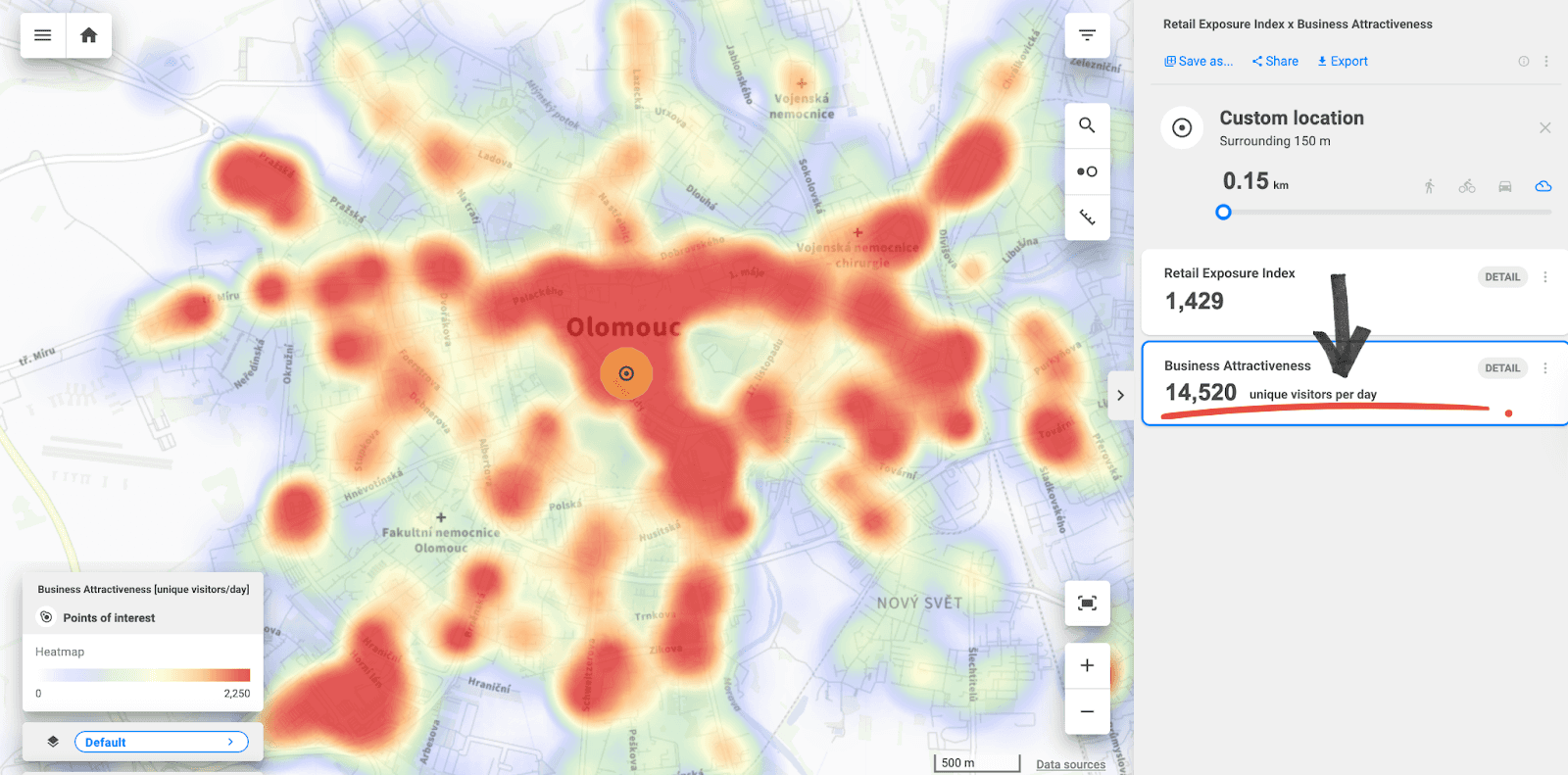
The visualization of the Business Atractiveness dataset in CleverMaps Studio.
What data can help estimate how many people are around a location?
This is where datasets based on spatial context come into play. By analyzing nearby Points of Interest and their influence on human presence, it is possible to estimate how many people are typically present in the surroundings of a location during a day.
The Business Attractiveness dataset by CleverMaps, the Location Intelligence platform, addresses this directly. The CleverMaps Studio translates the surrounding environment into an estimated daily number of people, replacing the older Retail Exposure Index with relative indices with a concrete and easy-to-understand value. Instead of saying that one place is “more attractive” than another, it shows how many people are likely to be there.
How can I work with this location data in practice?
To make such data useful, it needs to be easy to explore and understand. This is where CleverMaps Studio comes in. It allows you to visualize estimated daily presence as heat maps, zoom into specific locations, and compare multiple sites directly on a map.
By combining this view with other spatial data — such as competition or accessibility — you gain a much clearer understanding of how different locations perform in terms of people presence.
When should you use estimated people presence in location decisions?
Any time the success of a location depends on people being nearby, this type of insight is extremely valuable. It applies when opening a new branch, relocating an existing one, evaluating underperforming locations, or planning expansion across multiple areas.
As a neutral and general indicator, estimated daily presence works as a reliable starting point before deeper financial or operational analysis. Would you like to see how it works? Schedule a demo with us.